
Precision Bending Guide: Managing Copper Springback in Electrical Manufacturing
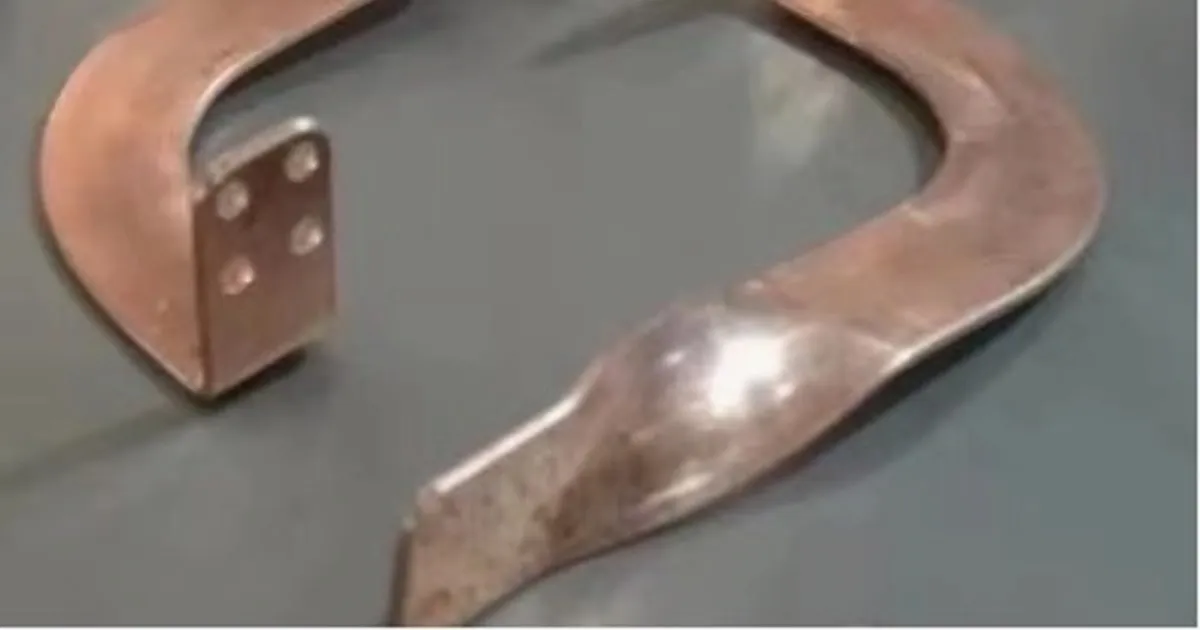
In switchgear assembly and transformer busbar fabrication, achieving tight dimensional tolerances is critical. Unlike structural steel, industrial-grade copper (such as T2 red copper) exhibits complex physical behaviors, specifically elastic springback, when subjected to high-tonnage deformation.
For electrical cabinet manufacturers, an uncompensated springback angle results in misaligned connection holes, mechanical stress on support insulators, and poor contact interfaces that can trigger hot spots or electrical arcing.
The Physics of Copper Springback
When copper is bent, the deformation zone experiences both plastic and elastic stresses. The tension on the outer edge exceeds the yield point, causing permanent plastic flow. However, the compression zones closer to the neutral bending axis remain in the elastic region.
Once the bending punch retracts, this internal elastic energy discharges, causing the busbar to partially unwind.
      Target Angle (90°)               Actual Angle after Springback (93°)
          |   /                               |      /
          |  /                                |     /
          | /                                 |    /
          |/                                  |   /
     [ Bending Die ]                     [ Unloaded Bar ]
The severity of the springback angle is directly governed by:
- Material Hardness: Half-hard copper (Y2) exhibits greater springback than soft, fully annealed copper (M).
- Radius-to-Thickness Ratio ($R/T$): Large bend radii relative to bar thickness amplify elastic recovery.
- System Pressure Consistency: Fluctuations in hydraulic fluid temperature alter viscosity, introducing random pressure variances on standard hydraulic machinery.
Bending Accuracy & Compensation Protocols
The DHAC-BB-H servo-hydraulic busbar bending workstation eliminates these physical variables through a multi-tiered compensation framework, which is also integrated into our flexible DH303-8P 3-in-1 multi-station busbar bending station.
1. Closed-Loop Servo-Hydraulic Feed
Instead of relying on basic timer-based cylinder extensions, our system couples an Inovance servo motor to an Italy Atos proportional valve. A high-resolution glass scale encoder tracks the Y-axis punch displacement down to ±0.02 mm repeatability.
2. Real-Time Thickness Sensing
As the bending punch makes initial contact, the PLC measures the pressure-displacement curve to determine the exact mechanical resistance of that specific copper bar. This dynamically offsets the springback calculation, accommodating normal thickness fluctuations of up to ±0.20 mm.
3. Integrated Over-Bending Algorithms
The HMI software includes built-in springback profiles. If an operator programs a target bend of 90°, the system calculates the required stroke to achieve a temporary 92.4° over-bend, ensuring the finished piece relaxes to exactly 90.0° with ±0.2° accuracy. Electrical cabinet designers can request a custom bending die design evaluation to review custom shapes, or browse our complete CNC busbar processing machinery catalog for all available machinery options.
Mechanical Comparison: Bending Precision
| Bending Parameter | Standard Mechanical Bender | DHAC-BB-H Servo-Hydraulic |
|---|---|---|
| Bending Angle Tolerance | ±1.0° to ±1.5° | ±0.2° (Factory Guaranteed) |
| Y-Axis Position Repeatability | ±0.10 mm | ±0.02 mm |
| Minimum U-Bend Inner Width | 50 mm | 40 mm (Ultra-Compact) |
| Drive Technology | Constant-Speed Hydraulic | Precision Proportional Servo |
Frequently Asked Questions (FAQs)
What is copper springback and why does it occur during industrial bending?
Springback is the elastic recovery of copper material when the bending force is released. It occurs because the outer fibers of the metal are stretched plastically while the fibers near the neutral axis undergo elastic deformation, pulling the busbar back from its target angle.
How does the servo-hydraulic system achieve ±0.2° bending accuracy?
Our closed-loop servo-hydraulic bender uses optical linear encoders and real-time pressure transducers to calculate thickness resistance. The Siemens PLC automatically adjusts the over-bend depth to offset the exact springback coefficient of the copper bar.
DHAC-BB-H Servo-Hydraulic Busbar Bender
Discover details, parameters, standard dies packages, and factory quotes.